
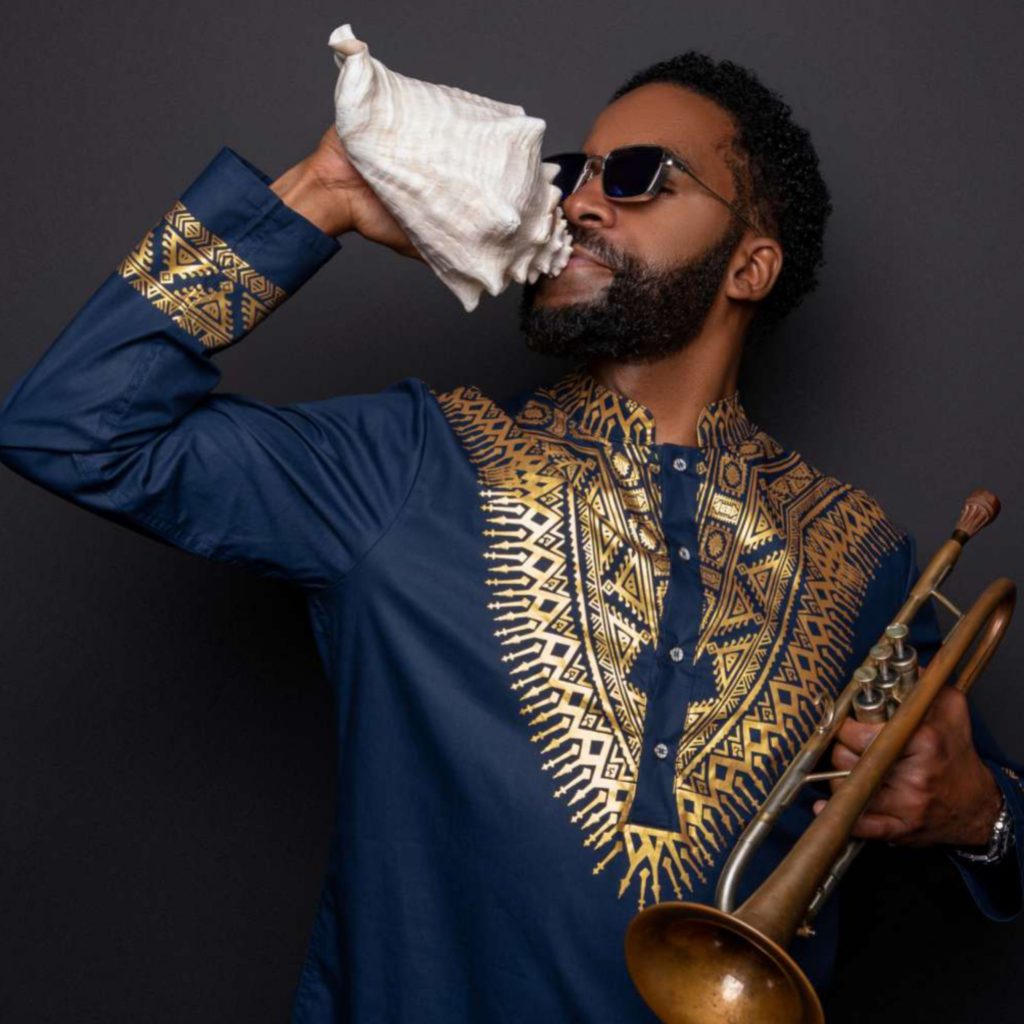
Global stages, jazz clubs, classrooms, and packed arenas — there’s almost no venue that award-winning artist and FIU alumnus Jean Caze MM ’07 hasn’t played in. Throughout his young career, he’s performed with artists such as Herbie Hancock, Aretha Franklin, Mariah Carey, and Arturo Sandoval. Today, Caze is a member of Michael Bublé’s touring band.
But music for Caze is more than just a performance in front of an audience; it is his way of sharing his Haitian roots and the culture that shaped him.
A Sound Shaped by Roots and Rhythm
Caze began playing the trumpet when he was just nine, but he recalls that it wasn’t his first choice. “I wanted to play the drums but was told I could only pick from the sax, the trombone, or the trumpet,” Caze says. “The sax has too many buttons [and] the trombone is too big to carry around. A trumpet, three buttons, easy.”
He later found out that “easy” was an understatement, but he stayed with it. Caze, an accomplished composer and multi-instrumentalist who also plays the flugelhorn and conch shell, doesn’t attribute his success to natural talent, “I don’t think I was naturally more talented than the other trumpet players,” he says. “I just think I loved music more.”
That love eventually became the foundation for a distinctive artistic voice. Caze describes his sound as a “consolidation” of himself, someone who was born in Haiti, raised in Queens, New York, and trained through the language of American jazz. Through his performances, Caze blends Haitian rhythms with jazz improvisation, creating music that feels rhythmic, soulful, and welcoming. He also uses the stage to teach audiences about Haitian culture, often sharing stories and inviting people to connect with the music through movement.
“I use my art as a way to not only consolidate both cultures musically, but also to educate,” he explains.
The First Time He Felt Heard
His first public performance — one of the most defining moments of his career — came long before the big stages and bright lights, when he was only nine years old. He describes himself as a shy child who often felt like people were not listening to him.
During that first concert, he stood up to play a small part of the melody. The audience responded with unexpected enthusiasm.
“That was the first time I felt heard,” Caze muses. “It was the first time I was being completely myself playing this instrument.”
That feeling still guides him. Even after years of training, touring, and performing, Caze tries to return to the instinct and honesty of that moment whenever he steps on stage.
Turning Talent into a Career
In order to make a career out of his passion for being a musician, he had to learn how to connect with people and develop his understanding of the business side of music.
“I realized other people that were at the same talent level were getting more opportunities,” he says. “Why? Because they were more outgoing.”
That realization pushed him to grow beyond the instrument. He worked on how he presented himself, how he built relationships, and how he approached his goals with more discipline.
FIU as a Place to Prepare for the Next Stage
After completing his undergraduate studies, Caze came to FIU for his master’s degree in music. By then, he had already seen how demanding the professional world could be. FIU became a place where he could sharpen his craft and intentionally prepare for life as a working artist.
“I said, ‘I’m going to use my master’s to get ready,’ and that’s exactly what I did,” he shares.
During his time at FIU, Caze focused not only on the requirements of the program, but also on becoming an entrepreneur. He evolved his presence in the music community — attending jam sessions, visiting clubs and restaurants, booking his own performances, and began developing the professional materials he would need to move forward.
“That was [when] I put together my website,” he says. “It was at that time that I made my first bio.”
FIU connected him with mentors who helped shape his growth. He credits Jim Hacker, his trumpet professor, and former FIU University Brass Choir and FIU Jass Studio Big Band Director, with helping him become a more consistent player. FIU Program Coordinator and Professor of Jazz Studies Gary Campbell helped open his ears and mind through patterns, exercises, and honest feedback. Former FIU Director of Jazz Sam Lussier, who led the big band, gave him responsibility and structure at a time when Caze needed both.
Those mentors helped him strengthen his technique, expand his musical thinking, and prepare for the expectations of a professional career. In February 2026, that connection came full circle when Caze returned to FIU as a guest speaker during Panther Alumni Week, sharing his experience to inspire the next generation of Panthers.
Caze sees being an FIU alumnus as an opportunity to give back. Now a music educator himself, he shares his genius and guidance with the next generation: encouraging them to experiment, ask questions, and embrace the type of hard work that challenges them and helps them grow.
Hear More from Jean Caze
Follow a fellow Panther as he continues to share his music and Haitian heritage through his work. Listen to his latest album, Dezòd, and keep up with his music, performances, and latest projects through his website, YouTube, Facebook, and Instagram.